
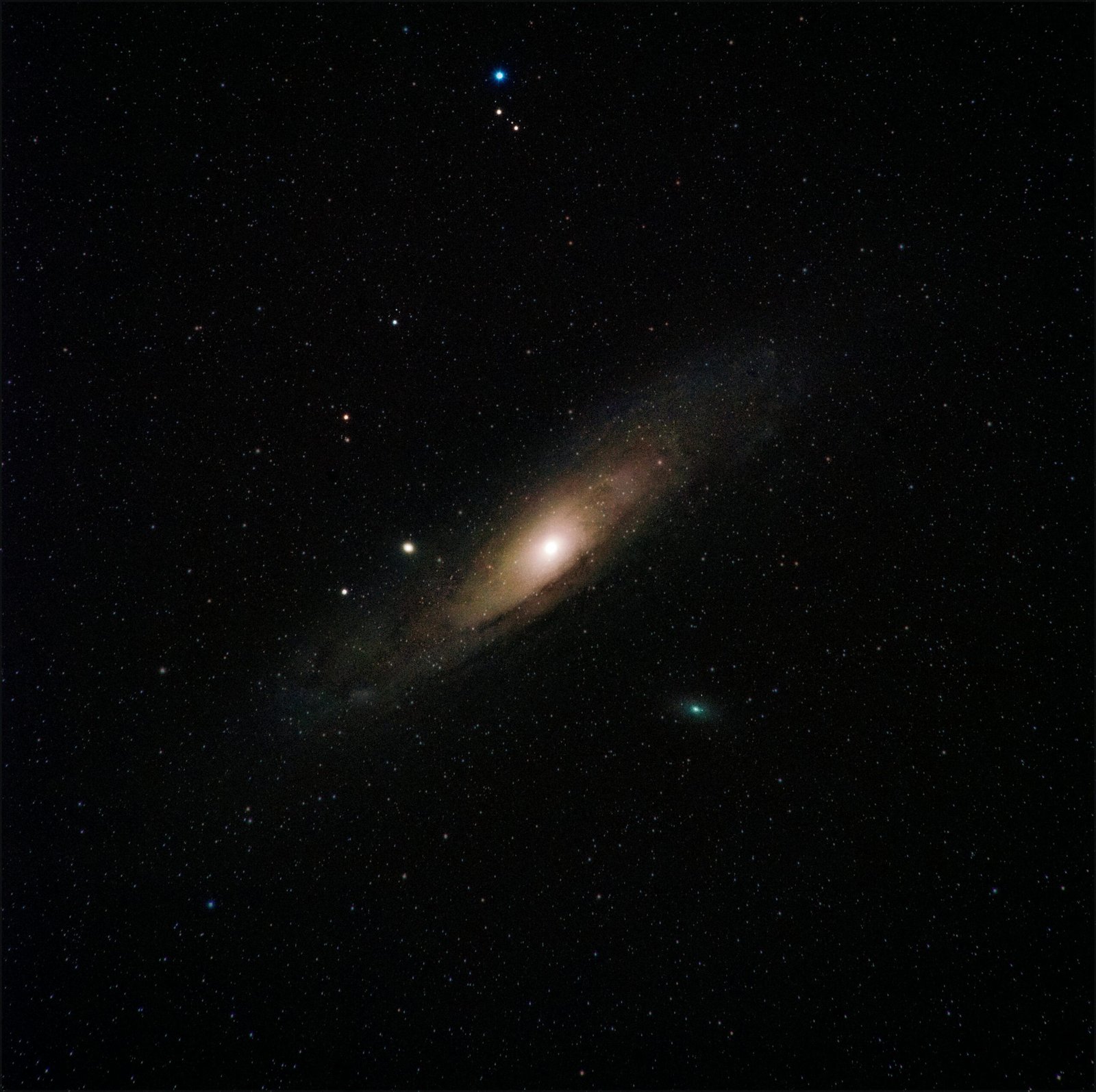
For decades, the collision between the Milky Way and the Andromeda Galaxy was considered a cosmic certainty—a “predestined” event scheduled for roughly 4.5 billion years from now.
However, in March 2026, the narrative has shifted. New data from the Gaia and Hubble space telescopes, combined with massive supercomputer simulations released in late 2025 and early 2026, suggest that our galaxy might actually dodge this “fastball.”
📉 1. The 2026 Update: Is the Collision Still Inevitable?
Recent studies have slashed the probability of a direct hit. Scientists now view the future of the Local Group as a “coin flip.”
- The 50/50 Chance: New simulations show there is now only about a 50% probability of the two galaxies colliding within the next 10 billion years.
- The “LMC” Savior: The Large Magellanic Cloud (LMC)—the Milky Way’s largest satellite galaxy—is playing a hero’s role. Its gravitational pull is acting as a “rudder,” tugging the Milky Way slightly off its collision course with Andromeda.
- The Timeline Shift: Even if they do collide, the most likely window has been pushed back. Instead of 4.5 billion years, a merger is now projected for 8 to 10 billion years from now—long after the Sun has exhausted its fuel.
🌌 2. If it Happens: The Birth of “Milkomeda”
If the 50% chance swings toward a collision, the result will be a multi-billion-year transformation.
- First Contact: The galaxies won’t “crash” like cars. Because stars are so far apart, almost no stars will actually collide. Instead, the two galaxies will pass through each other, their gravity stretching them into long, glowing “tidal tails” of gas and stars.
- Cosmic Fireworks: As the gas clouds from both galaxies compress, they will trigger a “firestorm” of new star formation, lighting up the sky with massive, bright blue stars.
- The Final Shape: After about 2 billion years of “dancing,” the two will settle into a single, massive, featureless blob known as an Elliptical Galaxy, nicknamed “Milkomeda.”
🌍 3. What Happens to Earth and the Sun?
By the time any interaction begins, the Solar System will already be fundamentally changed.
- The Sun’s Evolution: In 1 billion years (long before the collision), the Sun will become 10% brighter, likely boiling Earth’s oceans. By 5 billion years, the Sun will be a Red Giant, likely engulfing Earth.
- Orbital Shuffling: If the Earth somehow survived, the collision would not destroy the planet. Instead, the Sun would likely be nudged into a new, wider orbit in the outskirts of the new Milkomeda galaxy.
- The View: For any observers left, the Andromeda galaxy would eventually grow to fill the entire night sky, becoming a spectacular “milky blob” far brighter than the current Milky Way band.
📊 2026 Collision Probability Matrix
| Scenario | Probability (2026 Est.) | Estimated Timing | Result |
| Direct Head-on Collision | ~2% | 4.5 Billion Years | Immediate tidal disruption and rapid merger. |
| Close Encounter & Merger | ~48% | 8–10 Billion Years | Galaxies “dance” twice before forming Milkomeda. |
| The “Near Miss” | ~50% | Indefinite | Galaxies pass each other and continue separately. |
🔭 4. The 2026 “Galaxy Dance” Tech
To get these new numbers, astronomers used Monte Carlo simulations—running 100,000 different “futures” based on 22 different variables, including the mass of dark matter halos and the “transverse motion” (sideways speed) of Andromeda, which was notoriously difficult to measure until the 2025/2026 Gaia data releases.
Perspective: In 2026, the “Cosmic Trainwreck” has been downgraded to a “Possible Near Miss.” We are learning that the universe is less like a clockwork machine and more like a complex, slightly unpredictable dance.
- Create a comparison table of Milky Way vs Andromeda
- Summarize latest Gaia data on Andromeda motion
- Draft an executive summary on the LMC’s orbital impact

Leave a Reply